
Personal Property Loss Tax Deductions: Can You Write Off a Cabin Lost to Fire?
Jul 03, 2026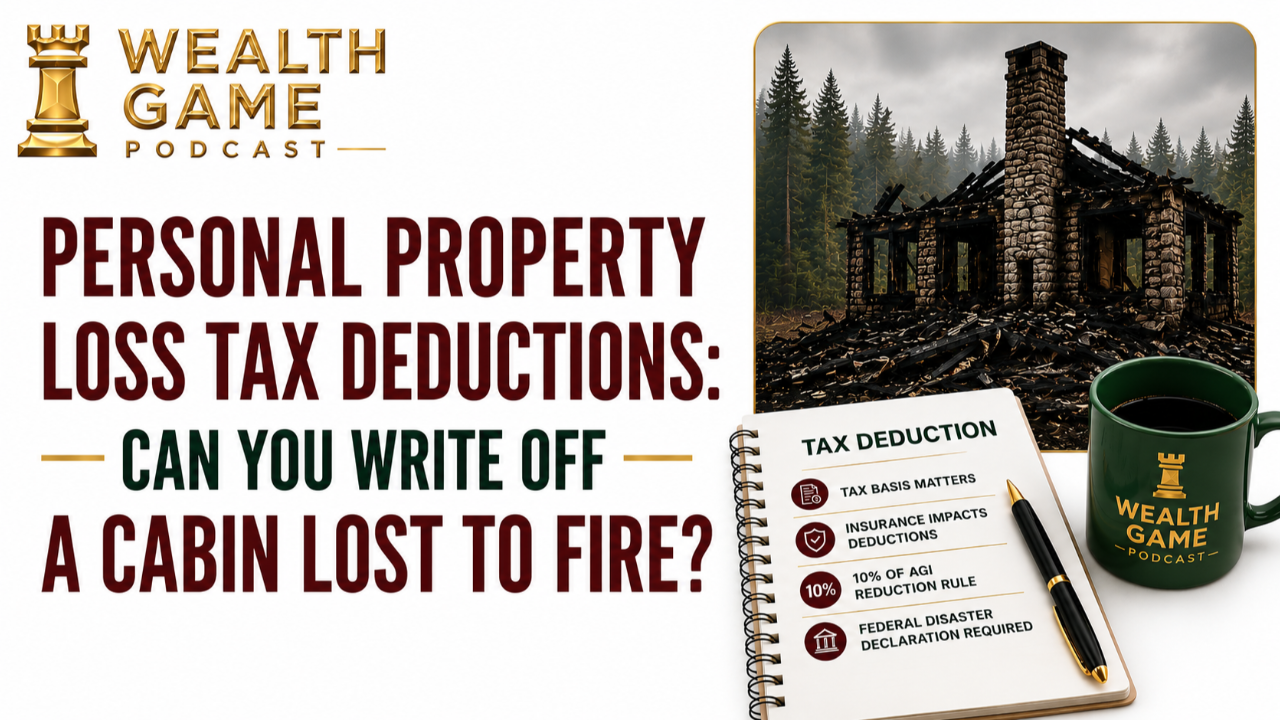
Natural disasters can leave behind more than emotional devastation—they often create significant financial losses as well. Whether it's a cabin destroyed by wildfire, a home damaged by a hurricane, or personal property lost in another disaster, one of the first questions many people ask is:
Can I deduct the loss on my taxes?
The answer is yes—but only under specific circumstances.
Many people assume that if they lose a million-dollar property, they'll receive a million-dollar tax deduction. Unfortunately, that's not how the tax code works. Several factors determine whether you qualify for a deduction and, if you do, how much you can actually claim.
Understanding these rules before filing your tax return can help you avoid surprises and ensure you're taking advantage of every deduction available.
Personal Casualty Losses: What Qualifies?
When personal property is damaged or destroyed by an unexpected event—such as a wildfire, flood, hurricane, or tornado—it may qualify as a personal casualty loss.
However, qualifying for a deduction isn't automatic.
The IRS applies several limitations that can significantly reduce—or completely eliminate—the deduction you may be able to claim.
Before calculating anything, you'll need to understand four key factors:
- Your property's tax basis
- The property's fair market value
- Insurance reimbursements
- Whether the loss occurred in a federally declared disaster area
Each one plays an important role in determining your deduction.
Your Tax Basis Matters More Than Market Value
One of the biggest misconceptions is that deductions are based on what your property was worth when it was destroyed.In reality, personal casualty losses are generally limited by your tax basis in the property—not its current market value.
Example 1: A Cabin That Appreciated Over Time
Imagine your grandparents built a cabin 30 years ago for $100,000.
Over the years, ownership passed through the family until you inherited it. Today, the cabin is worth $1 million.
If the cabin is completely destroyed in a wildfire with no insurance reimbursement, many people assume the tax deduction would be $1 million.
It wouldn't.
Because the property's tax basis remained $100,000, that's generally the maximum starting point for calculating your potential deduction—not the property's current value.
Example 2: A Recently Purchased Cabin
Now consider a different scenario.
Suppose you purchased that same cabin yourself a few years ago for $1 million.
If it's completely destroyed and there is no insurance reimbursement, your tax basis is now $1 million.
In this case, your starting loss calculation is significantly larger because your basis reflects what you actually paid for the property.
The 10% AGI Reduction
Even after determining your deductible loss based on your tax basis, another limitation applies.
The IRS requires you to reduce your deductible casualty loss by 10% of your Adjusted Gross Income (AGI).
For example:
- If your AGI is $100,000, the first $10,000 of the loss is not deductible.
- A $100,000 qualifying loss would become a $90,000 deduction before considering any other limitations.
- A $1 million qualifying loss would be reduced by the same 10% AGI calculation.
This rule can have an even greater impact on higher-income taxpayers.
If your AGI is high enough, it can substantially reduce—or even eliminate—the available deduction.
Insurance Reduces Your Deduction
Insurance proceeds also affect your casualty loss deduction.
Any reimbursement you receive generally reduces the amount of your deductible loss.
For example:
- If your allowable loss is $100,000, but insurance pays $500,000, there would typically be no deductible casualty loss because you've already been reimbursed beyond your tax basis.
- If your allowable loss is $1 million and insurance covers $500,000, you may still have a deductible loss, but it will be reduced by the amount you received from the insurance company.
Insurance doesn't necessarily eliminate every deduction, but it almost always changes the calculation.
The Biggest Requirement: A Federally Declared Disaster
Perhaps the most important—and often overlooked—rule is this:
Most personal casualty losses are deductible only if they occur in a federally declared disaster area.
This requirement surprises many people.
Two nearly identical situations can produce completely different tax outcomes simply because one location receives a federal disaster declaration and another does not.
For example, a single cabin destroyed outside a federally declared disaster area may not qualify for any deduction, while a similar cabin destroyed in an officially declared disaster zone could qualify.
This is why it's essential to verify the federal disaster status before assuming a casualty loss is deductible.
Why Every Situation Is Different
Casualty loss calculations involve several moving parts.
Your final deduction depends on:
- Your property's tax basis
- The property's value before and after the event
- Insurance reimbursements received
- Your Adjusted Gross Income
- Whether the loss occurred in a federally declared disaster area
Because these factors interact with one another, two property owners experiencing similar losses may end up with very different tax results.
Key Takeaways
- Personal property losses are generally calculated using your tax basis, not your property's current market value.
- Insurance reimbursements reduce the amount of any deductible loss.
- Personal casualty losses are reduced by 10% of your Adjusted Gross Income (AGI) under the rules discussed.
- Most personal casualty losses qualify only if they occur in a federally declared disaster area.
- Every casualty loss is unique, making professional guidance valuable before filing your tax return.
Conclusion
Losing a home, cabin, or other personal property is difficult enough without navigating complicated tax rules afterward. While tax deductions may provide some financial relief, they're far more limited than many people expect.
Before assuming you're entitled to a deduction—or assuming you aren't—take the time to evaluate your property's basis, insurance reimbursement, income limitations, and whether the event qualifies as a federally declared disaster.
Getting these details right can make a meaningful difference when preparing your tax return.
Ready to Make Smarter Tax Decisions?
If you have questions about casualty losses or other tax-saving strategies, the team at Bement & Company can help you evaluate your specific situation and identify the deductions available to you.
For more practical tax planning, wealth-building strategies, and real-world financial insights, be sure to explore more resources from the Wealth Game Podcast.
Want to start applying strategies like this to your own investments?
